Showing posts with label Momo Traders. Show all posts

Tuesday, 2 February 2016

The 'Chimp Paradox' and 'Trading': A metaphor for the workings of the trader's mind.

The Chimp Paradox, written by Steve Peters a leading UK sports psychologist, is an analogy based on simple metaphor for the batttle between the rational and emotional aspects of our minds and the interplay between them which underscores virtually every aspect of our lives.

The Chimp Paradox, is not a scientific theory in any way, rather it helps a person make sense of how our emotional/intuitive mind affects and impacts our decision-making capabilities.
The ‘Chimp Paradox’ metaphor describes the brain as working in two modes, the chimp and the human mode. The chimp mode (inner chimp) is the area of the brain driven by feeling, sensing, impressions, emotional thinking and gut instincts. The chimp is intuitive, makes snap judgments, thinks in black and white, and is capable of being paranoid, irrational and emotive. Its primary motivator is survival. On the other hand, the human part of the brain is rational, evidence-based, thinks in shades of grey, and operates on balanced judgement. The human part of the brain is driven by having a greater purpose in life rather than the pure survival instincts of the chimp. There is a third aspect to the metaphor, the computer within our brain. This computer, which had an empty hard drive at birth, is only as good as the information it contains and is limited by its operating system and hardware. The computer contains stored beliefs, some of which are positive, some negative, some deeply hard-wired and tough to change, and others easier to re-programme. Our personalities are formed by a combination of the chimp, the human and the computer, which both the chimp and the human refer to as their resource for their own respective reference points: All together they dictate how we think, feel, act and behave.

Given the chimps emotionally driven nature, the assumption would be that it is far better for the inner human to be in charge at all times. However life is not that simple, we cannot simply ignore or turn off our 'inner chimp'. This inner chimp is part of our nature, and as in real life, the chimp is far stronger than the human: You want to take on a chimp on in a fight? Forget it!! A chimp has 5 times the strength of the average human, so don’t even think of challenging him. Not only is the chimp far stronger, he has far more staying power, thus as the human starts to tire relatively quickly, so the chimp, who requires a lot less energy to function, starts to take control. In reality we function by being in a constant interplay between the two, rather like a hybrid car switching between battery and oil/gasoline. However, as mentioned, there will be times when our inner chimp, far stronger than our inner human, will takeover. At these times, where we are not switched on, tired, bored, or disengaged, our mind will be effectively hijacked. (Most people will be familiar with the term 'emotional hijack'). When this happens, the chimp can run riot, and the consequnces can be hugely destructive. The art of mind management is thus the ability to better understand your mind, including the inner chimp, the inner human, and how to keep the two in balance. It is when kept in balance and in check, that more  effective decision-making and greater performance comes to the fore. It is by keeping the inner chimp calm, that you can do better work. If you fight him you will lose, and you cannot get rid of him nor fully control him. What is even better though is to be able to work with him, make the inner chimp your ally. Examples are when you work in a 'state of flow'. I am sure you can recognise times in your lives or work, when you you achieved great things almost effortlessly, that is a wonderful example of the your inner human and inner chim working in harmony. This ultimately is the 'Paradox'; your inner chimp has the power to be highly destructive, sabotaging your best efforts and underming your goals and ambitions, or he can be a great source or power, helping you achieve great things, sometimes against all odds.

It is on the back of this metaphor that one can draw upon the success of outstanding performers in many fields, including trading and investment. Master performers learn to tame their inner chimp and work with it in practical ways to harness its enormous power’s of intuition, creativity and emotional strength. When combining the power of the chimp, and the logic and resourcefullness of the human, great things can be achieved. However, when fighting the inner chimp, surrendering to his simplistic ways, or attempting to placate him, we can undermine our own develpment and growth, with the consequnce that all our efforts are below that which we are capable of. 

How does this play out in the financial markets, where belief in the superiority of rationality and logic reign supreme?

We have been carrying out some fascinating research into the proclivities and behaviours of successful risk-takers. Our work is based around a number of banks and hedge funds where we coach traders and portfolio managers. The research is on-going and still its in early days, however we are seeing some clear trends emerging which may surprise some people’s expectations of traits and characteristics needed for success in financial markets. (We recently presented our initial work on trader personality as part of a webinar which can be seen here).

One of the aspects of our personality research we are seeing is a close correlation between success in volatile markets, and a tendency to favour emotional cues over rationality and logic, particularly when one is trading shorter-term time-frames. Perhaps this is not overly surprising when one links this to the ‘Chimp Paradox’. In fast volatile markets, the ability to make money relies strongly on an on ability to react fast to new news and seemingly irrational price action. Allying the human rational perspectives; a definitive trading plan with strict money management, with the chimps extraordinary sensing and intuitives abilities, enables individuals with these skills to thrive in short-term fast markets. However, allowing the inner chimp to run wild and take control, can undermine all the good work the inner human is capable of. - Have you ever wondered after a trading day, 'why the hell you did what you did?'. Well that was your inner human, questioning his actions, whilst not conscious or aware, that it was your inner chimp who temporarily was at the controls. Furthermore, your inner human will be trying to rationalise what you did and why you did it. In the end, in a desparate attempt to resolve this puzzle and to maintain his sense of worth (protecting his ego), the inner human will attempt to explain it away as an anomoly or an outlier in your behaviour. (He will be attempting to resolve a 'Cognitive Dissonance'). And thus, any learning which could have occurred as a result of that particular episode will likely be lost, and so you will be doomed to repeat the mistake in a repeating, self-serving behavioural loop.

It is only by mastering our minds and how we use them that we can really start to change, grow and breakout out to a higher level of performance. Relying solely on intellect, intelligence and rational perspective, can only get one so far. Learning successful interplay between our intuitive/emotional abilities and our rational/logical faculties is the key to surviving and thriving. Our recent interview with Brady Dahl, author of Momo Traders, revealed how these masters of fast markets are able to survive and thrive, often against tremendous odds. The traders featured in Momo Traders are masters of the art of allying their inner chimp with their inner human. In the coaching work we do with traders and investment professionals, this theme of mind management is one of the building blocks to how we help traders power their trading to be more productive and effective. The result of which has led to some quite extraordinary outcomes, as featured in the article 'The Extraordinary Return from Investing in Coaching for Professional Traders'. 

To know more about the chimp paradox, Steve Peters provides an excellent Ted talk on his 'Chimp Paradox' which can be seen below. The full title of his book is 'The Chimp Paradox: The Acclaimed Mind Management Programme to Help You Achieve Success, Confidence and Happiness'.


--------------------
You can follow 'Behavioural Trading' on Twitter and join the flourishing 'Behavioural Trading' Linkedin group.

You can also sign up for our 'Behavioural Trading' newsletter by completing the form below, or hitting this link . Please be assured your data will not be shared with any  outside parties, and you are welcome to 'unsubscribe' at any time.

The 'Behavioural Trading' blog is written and managed by leading Trading Performance and Behavioural Trading Coach Steven Goldstein. Steven is Managing Director at Alpha R Cubed, who work with banks, hedge funds and investment firms to help them improve their people's capabilities  within their frontline financial risk businesses. To know more about Alpha R Cubed, visit their website www.alpharcubed.com or email Steven at steven.goldstein@alpharcubed.com. Follow Steven directly on Twitter.


  Sign-up for the 'Behavioural Trading' Newsletter.


* indicates required


    Email Format


Sunday, 29 November 2015

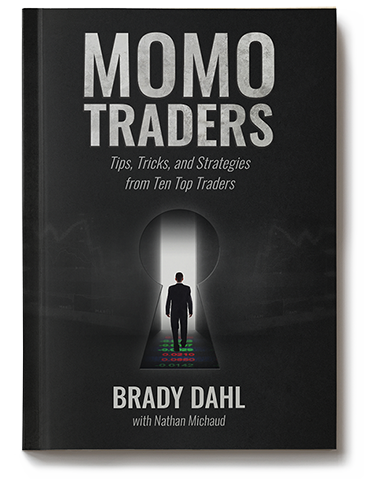
Momo Traders: Tips, Tricks, & Strategies from Ten Top Traders. - Interview with Author Brady Dahl.


'Momo Traders: Tips, Tricks, & Strategies from Ten Top Traders', is an exceptional new book from Writer and Trader Brady Dahl. It is to the private, internet based traders of today, what the 'Market Wizards' books were to he traders of the late 80s and 90s. In the following article, Momo Traders writer, Brady Dahl, has agreed himself to be interviewed about the book, and the insights he learned about himself as a trader, from writing the book. 

Book Review : Momo Traders
Most traders have read at least one of the Market Wizards books. Momo Traders follows in the path set by Market Wizards, however whereas Market Wizards largely features traders who made their fortune in the environment of the 80s and 90s, Momo traders is far more relevant to the modern day trader, working from home using the Internet. ‘Momo Traders’ is a book that most of the private traders working from home, or from one of the many private trading rooms which have sprung up, can relate to, irrespective of what markets they trade. .

‘Momo Traders’ is written by Brady Dahl in collaboration with Nathan Michaud of Investors Underground. Dahl, is a writer who trades, he has previously worked as a screenwriter on the hit US crime tv drama, ‘Sons of Anarchy’. As a writer, Dahl is able to keep the reader interested and captivated, and it is clear that his interviews have an engaging conversational style, which comes out throughout the book. Dahl is able to make the traders feel at ease through the interviews, thus facilitating thought provoking, insightful and at times compelling interviews. 
The unique aspect of this book is that most the traders featured have achieved great success from very humble beginnings. These guys are not the ‘masters of the universe’ of the 80s and 90s. Rather they are regular guys, who made mistakes, blew up, lost heavily, and yet persisted. These traders often had periods where they rode their luck too, but eventually they found a way, a method, an approach and a niche, which worked for them, and which eventually became the route for their own particular successes.

Like the traders it interviews, this book has the potential to be a future trading classic. Perhaps I feel there may have been one or two minor aspects which could have added some extra dimensions: Perhaps the inclusion of one or two traders of other markets; maybe FX, commodities, or energy. Saying that the theory behind trading is the same, whether you trade APPL, USDCAD, or West Texas Intermediate, it is the human aspect that matters to success, and this is what the book captures excellently. Perhaps, these extra elements could be included in a sequel. 

The Interview by Steven Goldstein

Brady Dahl, the writer of Momo Traders, has very kindly agreed to have the tables turned on him today by being interviewed himself. I hope readers of 'The Being of Trading' blog, enjoy his insightful and revealing interview:

SG: Brady. My first question: I am based in London, the word ‘Momo’ is not a word or term I am familiar with here in the UK. My assumption is that this refers to ‘momentum traders’. However, could you clarify for me and other non-US readers, exactly what the term means, and why this was used as the title for the book?

BD: You got it right. "Momo" is short for momentum. We used it in the title because the traders interviewed in the book constantly seek out momentum in the market—stocks about to have momentum, stocks currently with momentum, or stocks where the momentum has recently died. They know how to profit from "momo" in a myriad of ways.
SG: What motivated and inspired you to write Momo Traders?

BD: I always wished I could sit next to great traders while they worked and ask them dozens of questions. I wanted to know more about guys who traded like me, day traders working for themselves at home and earning a living. I wanted to know what made them tick, what they actually did all day, what tools they used, what action they were looking for, what strategies they found most profitable—basically any insight I could get.

SG: What was the aim or goal of writing Momo Traders?

BD: Well, co-creator Nathan Michaud and I had both read plenty of books on trading, but they all seemed to feature famous traders or hedge fund managers—guys who were trading millions and even billions of dollars, often using other people's money. It wasn't relatable to me and the guys I knew who started trading with a few thousand dollars of our own money and tried to eek out a living day after day. So the goal of the book was to showcase successful day traders and show the readers 10 varied yet completely attainable paths to profits. It's not easy, and the journey is different for everyone, but it is possible.

SG: As a writer of one of the most successful crime dramas of recent years, writing Momo Traders seems like a big departure for you. What challenges did you face in writing about traders?

BD: Well in this case, I couldn't simply make it up! Writing for film or television is an exercise in creativity, whereas writing Momo Traders was an exercise in editing. Believe it or not some of these interviews started out as over 50 pages of transcribed conversation. Without months of whittling and choosing what was most important, the book would have been 500 pages long.

SG: In terms of the interviews, attitudes and perspectives expressed in this book, what stands out for you in terms of recurring themes?

BD: Independence and freedom. These traders loathe the thought of working for somebody else and have spent the better part of their lives avoiding that. Of course they love what they do—trading—but they love the freedom it brings them even more. They have no boss, so whether they want to take the afternoon off or the next three months, they can—and do. It's not the money that brings them happiness but rather the time and independence.

SG: Whilst I loved all the interviews in the book, both ‘The Scanner’ and ‘The Rock’ stand out for me. Do you have a favourite interview or sections of interviews which really stood out for you?

BD: As a writer, 'The Storyteller' stood out most for me, because of the way Gregg Sciabica and I discussed taking into account all the variables surrounding a stock and creating the 'story' of the trade. But as a trader, I gained insight from each and every trader, even the ones with whom I didn't think I had as much in common. Some of the most eye-opening moments for me came from traders who have strategies completely different than mine.

SG: Was there anything that surprised you during the interviews?

BD: The most surprising element was just how open, honest, and forthcoming these traders were. They didn't shy away from answering any questions and never hesitated to discuss specific trading setups or techniques. When I asked them to walk through actual trades or most profitable setups, they did. And whenever I pushed for further explanation, they gave it.

SG: Can you tell the readers something about yourself as a trader?

BD: I've been trading since '08 with both good years and bad. Although I came to the market as an 'investor,' I soon saw people posting daily gains online of 50%, 100%, and even more trading penny stocks. I was drawn to the quick buck. Over the years I grew out of penny stocks and began trading any stock with a ticker. Currently I would say I primarily short sell momentum stocks that get over-hyped and overbought, but I—just like our readers—am working on all aspects of my game. I don't think the process of learning every stops, especially in trading

SG: As a coach, a big part of my work is to get people to self-reflect; to become more conscious of their inner-selves and how this impacts their trading and their engagement with risk and uncertainty. I am sure this project provided plenty of opportunity for you to embark on self-reflection, what did you find out about yourself as a person and a trader?

BD: Great question. Two of the biggest things that stood out to me while working on this book were my stubbornness and tendency to gamble. Both have actually served me quite well in other aspects of my life but are a detriment to my trading. I gambled when I moved to Hollywood with no connections and little money to try to become a screenwriter. And my stubbornness and determination not to fail helped me succeed in that endeavour. But great traders aren't stubborn. They don't need to be proven right in a trade. Instead, they cut losers quickly and move on to the next setup. Great traders also don't gamble. They deal in probabilities and let the math work. You have to work hard not to get in the way of your own success.

SG: You’ve just used a wonderful phrase, which I think every trader should heed: ‘You have to work hard not to get in the way of your own success.’ What new aspects of trading do you believe you have learned from the interviews which will help you achieve this?

BD: Reacting versus predicting. Most people, myself included, think successful traders are predicting price action. We think these geniuses must somehow have a gut feeling or intuition for where a stock's price is headed. Surely he knew XYZ was going to go up two dollars so he longed it right before it did. But what I've learned is that's not how it works at all. Most of these great traders—even if they don't know it themselves—are not predicting future action but rather reacting to current action. They see certain variables setting up—whether that's a news release, stock promotion, price action, volume, or any other stimuli—and then they simply react! They buy or sell based on similar setups they've seen in the past. Then, taking it a step further, if the stock doesn't do what they expected it to do, they react to current action again, by either decreasing size or stopping the trade altogether. That realization may sound simple to some, but it signifies to me that trading can be learned and that you don't have to be a prophetic genius.

SG: So what, if anything, will you do differently in your trading compared to what you were doing before?

BD: Have patience. I think it was Gregg who said we're not paid to sit at the computer and push buttons all day. We're paid to wait for great setups to come along and then capitalize on them to the fullest. Personally I forget that sometimes and begin to overtrade, but overtrading leads to taking losses on less than ideal setups.

SG: One of the things that jumps out to me from these interviews is that the interviewees seem to have no hesitation sharing their inner most thoughts and feelings. As least that is how it seems, would that be a fair assessment?

BD: Yeah, like I said, their honesty surprised me. But when I thought about it after, it made sense because these people are confident traders. They're confident in their current strategies and confident in their ability to continually learn and evolve with the market. None of them are worried about someone learning their 'secrets,’ so they’re willing to share.

SG: Where I feel Momo Traders really differs from similar books of this genre, is the focus on ordinary guys starting with virtually nothing, sitting behind computer screens and getting their information via twitter, social media and internet based services. What was it about these guys that attracted you to interview them and cover their work?

BD: Exactly that. The fact that they started with very little money, work mainly alone, all day, at home, and for themselves, just like me. They all grew into wildly successful traders doing things that are most likely within my realm of ability, so I set out to absorb as much of their knowledge as they would allow.

SG: I have spent 30 years in and around bank trading rooms. Yet this business never fails to surprise me. What has reallysurprised me is the extraordinary results achieved from such minimal initial resources. What qualities do you feel were a major aspect of the success of these particular traders?

BD: Mainly their determination. Most of these traders blew up at least one, if not several, accounts in the beginning of their careers. And that's when 90% of the other traders quit and never came back to the market. There's a saying in Hollywood that talented writers and actors move home every day, basically meaning the people who "make it" in the business are simply the ones that stick around long enough to outlast the others. And I believe it works similarly for trading. The guys who get back up every time they're knocked down, who don't let losses take over their emotions, who stick with it day after grueling day, are the ones who make it.

SG: My coaching work with traders, typically inside banks and hedge funds, has enabled me to identify many of the same themes and traits which seem present in the traders featured in Momo Traders. What would you describe are the major personal traits which were common amongst these traders which were key factors behind their success?

BD: Besides the determination we already discussed, I'd say all these traders are very disciplined. Even the ones that seem a bit wilder are still disciplined in their own way, otherwise they wouldn't have lasted in the trading business this long. Their discipline allows them to do two very important things, without hesitation—1) Enter the trades that present themselves, and 2) Stop the trades when they're not working. Sounds easy enough, right? But most traders fail because they don't do one or both of those things well enough.

SG. That’s a fascinating response. Nearly all traders tell me they’d like to be more disciplined, however what disciplined means for one guy, means something totally different for the next.

SG: In my many years as trader I could not imagine working from home on my own. It did try it for a short time, but the loneliness nearly killed me. It must take acertain type to be able to work from home on your own?

BD: Absolutely. Just ask my wife. She'll tell you it takes a deranged lunatic to work from home all by yourself every day. And sometimes I agree with her! But in all seriousness, I do think it takes a certain type or person. I love the freedom it allows me, but again, it comes back to discipline. I answer to nobody but myself, which is a great luxury, but if you're the type of person who would rather sleep in a little later or watch Youtube videos all day instead of work, it may not be the best thing for you—you may need a boss to push you. But for me—It's Sunday at 11pm right now and I've been in my office working for the last 7 hours. Sometimes I wish the Boss-Me would give the Work-Me a break.

SG: What is it about your book which you think will most attract readers to purchase Momo Traders?

BD: The honesty from ten great traders. Where else can you learn from successful traders who speak freely and openly about their finances, how much money they keep in accounts, and how much money they put to work and in what increments in specific trades? Also, many traders have reached out after reading the book and thanked us for putting it together, saying all kinds of nice things and talking about how it has helped their trading, which has been very rewarding for us to hear.

SG Aside from telling aspiring traders to buy your book, what one piece of advice would you give to traders setting about on embarking on a career in trading?

BD: It's one thing, but I'll say it three times: Cut your losses, cut your losses, cut your losses. Don't ever let a loss run thinking that it will 'come back eventually,' because it usually doesn't. And even if it does, how long did it take, why did you need to go for that ride, and what toll did it take on your mental health? You can always re-buy or re-sell if the trade sets up again. There is absolutely no good reason to hang onto a loser, yet it's probably the number one killer of beginning traders. Learn to love the loss. Cut it quick, keep it small, and move on. That one small discipline will allow you to maintain your account value for as long as possible while you try your hand at trading. Oh, and cut your losses. Did I say that already?

Brady thank you for the interview.

I highly recommend investing in a copy of 'Momo Traders'. It could be one of the best investments you ever make. In addition, it is worth noting that some of the profits from the book will be going to good causes through the charity ‘Traders4ACause’. To buy directly and/or to purchase the e-book, go to https://www.momotraders.com/ or alternatively the book can be purchased on Amazon and other online book retailers.  

Steven Goldstein is a leading Performance Coach working with Traders, Banks and Hedge funds at AlphaRCubed Ltd: To know more about Alpha R Cubed, visit their website www.alpharcubed.com or email Steven at steven.goldstein@alpharcubed.com

To view a brochure on their work click the link here

To subscribe to their monthly newsletter, email info@alpharcubed.com, and request brochure and or newsletter. 

Follow Steven on Twitter and Linkedin

Join the flourishing linkedin group Trader, Trading & Risk Psychology.

Thursday, 5 November 2015

Is it possible to win at trading, without a distinct 'information advantage'?


Any success at proprietary or day trading is down to luck, inside information, or an edge due to circumstances.’ This view was expressed to me by a client participating in a coaching programme I was delivering.- This comment sparked a discussion which turned out to be one of the more interesting ones I have had on this subject. That the client was a major options market maker at a tier 1 bank, only added extra spice. 

This trader, offered himself up as an example: He saw his success as being down to an ability to work an edge which resulted due to favourable circumstances. The circumstances; his position at a major tier 1 investment bank with  vast resources of capital, computing power, client flow and information flow. Additionally as a price-maker, he always had the spread his favour, thus he was able to warehouse risk and optimise the various edges he had from his privileged perch. He felt that any success achieved by being on the other side of the table from him, as a proprietary trader without a 'privileged information' edge, was an impossible task achievable at best with luck.

I disagreed, proffering examples of private traders, bank and hedge fund traders that I had known or known of, who had achieved this feat. I also drew on my own experiences as a trader. My contention was that you could make consistent money through trading by skillfully navigating the markets. For this individual however, there was no budging in his conviction. A conviction I feel was coloured by cynicism based on his experience having worked inside two major tier 1 banks. History since then has shown exactly how much information advantage was tipped in the favour of the big banks. (Libor/FX Fixings, privileged central bank information, sharing of information on clients flows, etc.). In his opinion, any examples I put forward were just people who either did not reveal, or were not conscious, that they had inside information, or were just on the upside of the good-luck/bad-luck lottery.

This trader used an example to highlight the good-luck/bad luck lottery. He claimed it as analogous to participation in a competition based on a random coin toss. He argued that it was analogous to a coin-toss competition involving thousands of people each calling a coin toss. Each time you lost you were eliminated, and eventually there would be one winner. If you repeated that process many thousands of times, there would be a select few who as luck would have it had won a number of times. Those lucky winners may start to think they are good at this.  If you added in the information advantage aspect, then there might be people who had advance information on the coin toss outcomes, they would then win very often and would confuse that success with skill. His argument was not without some merit, however it relies on a premise that markets are random, a point I disagree with. 

My opponent in this argument was not budging, he compared it to the same way you cannot beat the house in blackjack on a consistent basis, unless you can count cards (Privileged information). I  believe poker to be a better analogy for trading than blackjack. In poker the cards are dealt randomly, but how the hands are played is not random, thus the game is now no longer the result of randomness. In much the same way that (in the absence of inside/privileged information) news and data is released into the market in a random way, however people do not react to it in random ways, and thus the market’s price moves are no longer random.

It follows that all market  moves are the results of human decisions (I will ignore Algos for now for the sake of simplicity). The burgeoning field of behavioural finance has revealed over recent years, how people’s decisions are biased: People do not make wholly  independent rational judgments, they are influenced by a host of matters, from the behaviour of the crowd, to their own levels of fear, to predispositions to certain default responses.

I believe poker is a great analogy to trading. It is a game of skill and chance combined, there are good players, bad players, and exceptional players. Poker is a zero sum game, all the money goes to the ultimate winner(s), if there are ten people in a game, the losses of 9 become the winnings of 1. Not unlike trading, where it is believed that only about 5 – 10% of traders are ultimately successful. Of course not everyone can be a champion poker player, but many can be very good at it, and many can learn to be much better.

I believe there is enough evidence out there to suggest that is skill involved in trading success. Often the best testaments are the consistently successful traders and investors themselves, the Buffetts, Mungers, and Dalio’s of the world. Jack Schwager has written about scores of successful traders in his 'Market Wizard’s' books, though cynics may contend that these are examples of the lucky ones, or more probably they may have had inside information, drawing on the constant suspicion which dogs Steve Cohen, as an example. A better example of how skill leads to success in trading is shown in an excellent new book, ‘Momo Traders’, by Brady Dahl. 'Momo Traders' documents ten day traders, in a Market Wizards style interview process. These guys do not have the luxury of capital or backing which may have helped kick-off a Paul Tudor Jones, or a George Soros. Nor do they possess the huge funds and resources which can help develop relationships which might provide ‘privileged information’. These traders,, starting with very small accounts on their own from a laptop in a bedroom, have used skill and have developed mastery to become highly successful day traders. They can boast annual profits sometimes in the millions, and without even a sniff of informational advantage.  

I have known my own ‘Momo traders’, here in the UK and Europe. Traders who are successful without any clearly defined ‘informational edge’ or ‘favourable circumstances’. When I coach traders I often explore the analogy between trading and gambling in card games. In poker there are only ever a small number of consistent winners, and to be part of that number requires more than just knowing the odds associated with each hand. Success requires becoming a master of yourself, your emotions, your behaviours, and your senses. Chance is involved, but the skill is in how you master chance, how you manage yourself when faced with uncertainty, how ‘risk intelligent’ you are. As a 'trader performance coach'  I know how developing people's behavioural characteristics, and how they engage with risk makes a significant difference to their performance. Recently we published an article, can be seen here, which highlighted the extraordinary returns possible from performance coaching. These improvement could not happen if luck was the reason for success. Like poker, the winners in trading do not win every hand, or even very tournament, but they do win over he long run, and that is not down to luck.   

                                         _______________

Steven Goldstein is a Performance Coach working with Traders, Banks and Hedge funds at Alpha R Cubed Ltd.  

To know more about Alpha R Cubed, visit their website www.alpharcubed.com or email Steven at steven.goldstein@alpharcubed.com.

To receive a brochure on their work, and to subscribe to their monthly newsletter, email info@alpharcubed.com, and request brochure and or newletter.

Follow Steven on Twitter 

Connect with Steve on Linkedin  

Join the flourishing linkedin group Trader, Trading & Risk Psychology.

Poker Cards & Chips image courtesy of Mister GC at FreeDigitalPhotos.net


AlphaMind podcast #107 A US Navy Seal Commander, A Mindfulness Expert, and Self-Compassion

In the brutal world of trading and markets, we can often turn in on ourselves, and end up becoming our biggest problem. The ability to stay ...