Showing posts with label Investment Psychology. Show all posts

Friday, 11 December 2015

'Why on earth would I employ a coach for my traders?'


 'Why on earth would I employ a coach for my traders?'

That was the retort from the head of trading of a fixed income unit of one of the world's leading investment banks. -He added, 'We have some of the best traders in the financial markets, these are the last guys in the world who need coaching'.

Imagine how would it sound if the head of major sports franchise took the same attitude to their top talent.' : 'Guys, we've spent millions bringing you in, the next game is on Sunday, just turn up and do your best'.

Sports franchises and clubs spend millions on coaching their top talent, getting the best out of them, physically, mentally, psychologically, strategically. The military does the same, their special forces fighters receive more training, coaching and development than any other part of the armed forces. In business, most senior executives in the world's leading corporations receive high powered executive coaching, the world's top executives coaches, such as Marshall Goldsmith can charge seven figure fees to work with CEO's, COO, and senior executives, and still they are queuing up to work with him. Meanwhile in the medical profession, medical practitioners spend thousands every year continually updating their professional capabilities. - So how come the 'Trading Profession, where individuals who daily trade notional sizes in the trillions of dollars, seem to think they alone do not need to develop, hone and improve their skills and capabilities? 

What can Trader Performance Coaching Do?

First it would be helpful to try and understand what professional trader coaching is and what it can do. - Coaching, at the level we are discussing is akin to a professional sports coach, where the coach facilitates the performers or team to be at their best and to achieve their best to meet the competitive challenge they face. Novak Djokovic does not employ a coach because he needs to learn how to play tennis, nor does he need to be pandered to about how be could be a better player. Rather he has coaching to help him refine his game, to keep himself sharp, to work on enhancing his edges, and to have someone who can challenge him, cajole him, and keep him motivated. A coach is someone who can help a person improve in all areas and aspects of their performance, working with them to help them become more self aware. Then helping them take that raised awareness and translate it into strong performance, and better outcomes. 

High quality performance coaching for traders works in a similar way, though it might be fairer to compare it to executive coaching. Executive Coaching is a facilitative one-to-one, mutually designed relationship between a professional coach and a key decision maker in an organization. The coaching is contracted for the benefit of the decision-maker who is accountable for highly complex decisions with have a deep impact on the performance of the firm.  

At Alpha R Cubed, we work with some of the financial market's top talent inside hedge funds, investment banks, and commodity trading firms. Our work aims to make traders and professional investors stronger as risk takers, helping them improve their decision-making around their work, helping them improve their resilience to stress and anxiety, and improving how they function in the highly uncertain, complex and extremely challenging world of financial markets. Our coaching aims to take people from 'good to great', and from 'great to outstanding'. The coaching helps people understand more about themselves, how their personality impacts their behaviour and what blind-spots they possess. We help them become more mindful and conscious of the blindnesses, which Daniel Kahneman stressed in his comment, 'We are all blind to our own blindnesses'. 

Trader Performance Coaching works with people to help them refine their own trading edges, develop their performance, improve their confidence, enhance their self-belief, improve how they cope with stress, and help better manage themselves and their emotional drivers which impact decision-making. We do not tell people how to trade, nor do we encourage them to change their approach, alter their style, nor adopt a different methodology. We work with people as they are, not how we think they should be. At the core of our work we are informed by the principals of 'behavioural finance. We also look to help them cultivate improved levels of risk intelligence a particular type of intelligence, distinct from intellectual and emotional intelligence, which people use for thinking about risk and uncertainty. Additionally the coaching looks to help  this we work with them to improve their emotional intelligence, develop greater resilience, and cultivate positive psychology in relation to how they engage with risk. - The coaching gives traders a chance to look at their process, practices, behaviours and attitudes, in a way they have never looked at them before. There are many areas of trading and investment performance that are ripe for refinement; analysis, risk management, money management, execution, trade management, portfolio management, position-taking, individual resilience, mindset, focus, attitude, beliefs, behavioural biases, ego management, team working and relationship management skills when working  with sales, quants, investors, the list could go on.  

At the root of coaching for traders, as in the case with many forms of coaching, it is about  working with the individual to be able to help them improve their decision-making in whatever challenges or environment they face. With traders, and investment professionals, it is ultimately about helping them to be able to make better decisions and choices in fast volatile and highly uncertain environments, where emotions can very easily throw people off track and effect their ability to make sound decisions at key moments.   

Examples of Trader Performance Coaching interventions:

It is not always easy to demonstrate the benefits or returns possible from coaching, often the results are not clearly quantifiable or easily determined. We have however attempted identified to capture some examples where we can demonstrate the returns. These examples are based on clients stating how much difference they think the coaching made. A previous article, The Extraordinary Returns from Investing in Coaching for Professional Traders and Portfolio Managers, highlights these examples. The table below summaries these. 
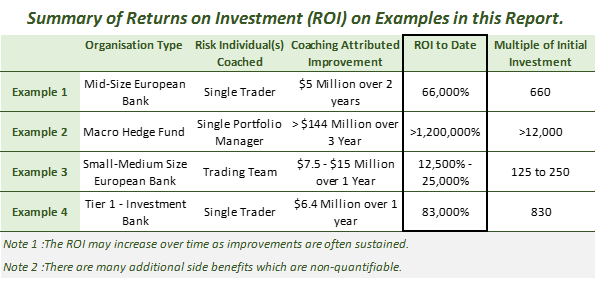
The exceptional returns on investment highlighted sometimes do appear ridiculously off the scale, however the client themselves expressed these as fair summations. Part of the reason for such exceptional returns, is the size of the notional values when people are trading in  financial markets, a small difference in actual performance, can translate into major gains in financial terms. One aspect not captured in these examples, is the difference the coaching made on non-measurable aspects. A client we have just finished working with, not included in these examples, has reported how he is seeing so many other improvements in all areas of his working (and non-working) life. This was reflected in his end of year review at his firm, a tier 2 investment bank with some 2000 employees in the trading business worldwide. Each employee has an end of year review whereby they are given a star rating, only a handful of employees receive a 5 star rating, even a 4 star rating is not readily given out. This year the individual was given a 5 star rating, as opposed to the 3 star rating he has always previously received. In addition, he is now being put into the firms management programme, something that was not even on the radar for him previously. It is worth pointing out that in terms of performance, he has just had his best ever trading year out of 15 years trading, more than doubling last year's performance. His story is not atypical by any means, we have received much feedback similar to this. 

Why on earth would I employ a coach for my traders?

In response to this statement made at the very beginning. I hope I have laid down a strong case why a firm should employ coaching for his traders. Whilst the case is strong alone based on performance alone, banks are under pressure to demonstrate steps they are taking to raise standards of professionalism within their trading businesses. In the UK, the Fair and Effective Markets Review (FEMR), demands this of banks. A more complete list of the many benefits of our work can be seen on our website at http://www.alpharcubed.com/coaching.

Steven Goldstein is a leading Performance Coach working with Traders, Banks and Hedge funds at AlphaRCubed Ltd: To know more about Alpha R Cubed, visit their website www.alpharcubed.com or email Steven at steven.goldstein@alpharcubed.com. 

To view a brochure on their work click the link here. 

To subscribe to their monthly newsletter, email info@alpharcubed.com, and request brochure and or newsletter. 

Follow Steven on Twitter and Linkedin. 

Join the flourishing linkedin group Trader, Trading & Risk Psychology.


Tuesday, 13 October 2015

The Extraordinary Returns from Investing in Coaching for Professional Traders and Portfolio Managers.


The last few years have seen a sharp growth in the use of coaching for developing trading and investment performance. This growth echoes in the many ways the rise of ‘Executive Coaching’, which is used to develop top leadership talent, and elite ‘Sports Coaching’ which is used to develop top sporting talent. The growth of performance coaching for traders still face many challenges, including an inability to provide data to a results driven industry which shows the ‘added-value’ from coaching. However for the first time, ‘Alpha R Cubed’, a bespoke trader and portfolio manager performance coaching business, has attempted to show the returns possible from using coaching to improve trading performance. This article highlights four examples of the work of their coaches taken from a wide body of work over recent years.

The table below summaries the results of the examples used in this article. The results seem exceptional, and as Alpha R Cubed's Managing Director Steven Goldstein explained, we were almost a bit embarrassed when we did our calculations, we had to keep double checking the numbers, or wondering whether we right to claim these improvements. However when we thought about it, we decided to use these, as they were deemed by our clients the additional returns which they feel would not of happened without the coaching:
  
What exactly is Performance Coaching for Traders, Investment and Portfolio Managers?

Performance Coaching is an immensely powerful process whereby a coach works with an individual to challenge and support them to achieve greater levels of performance. The coaching occurs in a series of one to one meetings held off the trading floor and spaced out over several months. The coaching is supported by various forms of analysis including risk profiling, personality assessment, 360 degree feedbacks, and behavioral questionnaires. In helping explain what the coaching tries to achieve, Alpha R Cubed’s Steven Goldstein likes to quote Sir Edmund Hillary, ‘It’s not the mountain we conquer, but ourselves.’ He says for many traders, often the problem is the enemy within, the coaching supports and helps traders to overcome the enemy within and then turn it into the ally within. As a consequence people start to improve and even master their abilities in key areas of performance, they become better at engaging with risk, better at managing risk, and better at making decisions in uncertain situations.
 
Examples of the Performance Coaching with Attributed Returns.

In all the following examples, the client firm stated the added-value that they believe resulted from the particular piece of coaching work. The clients involved provided permission to publish the details, though they did request anonymity in order that confidentiality is maintained.

Example 1

The individual was an experienced FX trader who had consistently returned a profit of about $2.5 million per year in recent years. A respectable performance for a mid-size franchise FX business, however the head of trading felt this individual could achieve higher levels of performance.

The coaching explored the trader’s way of working, approach and attitudes. This trader was highly talented but felt that he could not significantly improve performance without sacrificing low levels of volatility, or risking a counter-reaction to his performance. The coaching worked on raising the individual’s self-awareness to a point whereby he became more conscious of powerful drivers influencing behaviours which he had previously been blind to. As the coaching proceeded the trader started to introduce adaptions and a more proactive approach to his trading. 

By the end of the first year of coaching the trader had achieved a profit for the year of around $4 million, the following year this increased to $6 million. Collectively, the two years since the coaching have seen the trader generate an improvement to the bottom-line of an additional $5 million. This equated to an ROI of over 66,000%. Whilst this is extraordinary in any ones language, it is probably on the conservative side given that it excludes continued future performance and other non-quantifiable benefits. Furthermore, if the traders run rate remains elevated at around $6 million per year, then it is feasible that the return over 5 years would equate to an ROI of over 200,000%. Whilst this is a good example, it is not extreme  nor untypical.

Example 2
Where higher levels of capital and leverage are available, the return on investment can be considerably higher as this example shows. A newly hired portfolio-manager at a leading hedge fund had been highly successful as a bank trader. His first year at the hedge fund had however been somewhat underwhelming, achieving only a small positive return for the year, and finishing in the bottom 10% of PMs at the firm. This particular fund does not normally retain PMs who perform poorly in their first year; however, in light of his potential, they decided to give him a further chance and enlisted one of Alpha R Cubed’s coaches to help him.

It was apparent he had struggled to make the difficult transition from bank to hedge fund. There was a very different trading and risk environment at the hedge fund and the pressure to perform was far more intense. The coach worked with the individual to help raise his awareness of the issues which were impacting his performance, investigating the roots of his trading style, and exploring the unconscious biases at work in his trading. His approach to risk, which he had applied at the bank, needed some serious modifications, whilst his attitude to discipline and money management needed to be re-appraised. The individual soon started to transform how he worked, adding a new level of discipline and incorporating new practices and processes. The results were almost immediate, and by the end of the next six months not only was he retained but he was given an additional injection of capital to trade with. His second year at the firm saw a dramatic turnaround, placing him in the firms top 5% of their PMs. His total P&L for that year saw an increase of over $48 million, whilst in the subsequent two years he exceeded this still further.

In its raw form, compared to a situation where had the firm decided to let the individual leave, the ROI equated to a first year return of over 410,000%. The exact numbers for the PM’s performance in the subsequent 2 years were not available, however it is known that both years were in excess of the $48 million achieved in the first year after coaching. It is therefore fair to assume that ROI on this particular investment is so far at least 1,230,000%. It could be argued that the returns in this case are exaggerated, since the individual always had the potential; however the firm recognized the contribution the coaching made and that it was the catalyst for him to fulfill that potential. Furthermore, even if the coaching had achieved only a fraction of this success, it still would have represented an extraordinary return. 

This fund subsequently adopted the coaching to improve the ‘on-boarding’ process for new hires, and as a consequence the success rate of new hires has significantly improved. This is a great example of how supporting people in high pressure trading roles, pays huge dividends. It is felt that many firms fail to support people adequately when it comes to the human aspect of performance. This was brought home further by a recent research paper published by Citibank*. This explored the positive effects that active people management practices, which includes coaching, has on performance at hedge funds. The paper found that over a 3 year period, funds that invested heavily in active people management, outperformed funds that under-invested by around 600bp on total AUM. In hard numbers, this approximates to enhanced returns of around $200 million per year for every $10 billion of AUM.
*Exploring the Concept and Characteristics of “People Alpha”: Citi Prime Finance, October 2013.

Example 3

This example highlights a more broad based improvement across a whole team rather than

a specific individual. The coaching had been working for two years with 12 traders and desk heads within the fixed income, currency and commodity (FICC) trading business of a small to mid-size European bank. After two years the head of the business sent an email stating the following:-

‘We are again looking forward to cooperation for this year, last year we improved our trading P/L by more than 10 MIO GBP and I would argue that our cooperation was a big part of the success.’ 


We do not know how much of an increase this was in percentage terms, however we do know that for a small to mid-size European Bank, this was a sizable increase. And when compared to the average performance within the entire industry, where average revenues for FICC trading business for the year were around 7% lower than the previous year, this was an even more outstanding outcome.

It is not possible to know how much the coaching contributed directly to this, if one conservatively assumes that the coaching contributed to around half the improvement, this equates to an ROI of around 12,500%, whilst full credit for the improvement would equate to an ROI of over 25,000%. This may understate the full contribution, since the improvements are often maintained. Thus potentially this could equate to an ROI over a 5 year period of anything from 62,000% to 125,000%.

Goldstein does admit states that ‘it is not always easy to know the true value of their contribution, after all ‘a rising tide lifts all boats’ ’. Alpha R Cubed rely on feedback from clients as the best indicators of value. A good example of this is shown in feedback a ‘Business Head’ provided to the ‘Head of Talent’ at a Tier 1 investment bank client. The ‘Head of Talent’ had requested an assessment of the value of the coaching to the business. The following is taken from the manager’s reply:

‘Trader 1: Best year prior to coaching $6m (Over an 11 year period). Years since: $32m followed by $20m this year. (He started mid-way through 2007 and was flat p/l but just shy of $7m by year end)

Trader 2: Best year prior to coaching $0m (Associate, showed promise but revenue wasn't happening for some reason). Since he has $8m and $12m this year.

Trader 3: Best year prior to coaching $8m; subsequently $28m and $15m

Trader 4: Best year prior to coaching $3m: subsequently $22m (just one year since).

Now obviously market conditions have played a part, as well as luck etc. But one trader who has declined to take part in the 'coaching' has turned out to be the lowest revenue producer for the past two years having been consistently the highest for the previous 5. Also, all the individuals that have taken part have become easier to manage, show greater teamwork and just appear to be happier overall. The positive impact on the group has been profound.’


Example 4

Whilst the coaching focuses mainly on developing potential, sometimes it is remedial in

nature. An experienced swaps trader at a bank was struggling to recover from a serious downturn. When the coach met with the trader he was down $2 million dollars for the year and bleeding confidence. Soon after starting the coaching, the trader had lost a further $400,000 and closing in on his yearly stop-loss. The coach suggested he cease running risk to help him get his head ‘sorted’ and to stem the negative spiral .Then the coach worked with him to explore and help him understand the complexities of his situation which had taken him on this negative spiral. After a few weeks the trader re-started taking risk and within a couple of months was starting to make money again. With his confidence improving he continued to get further back into the markets, and by the end of that year he had made back almost $1,400,000 from the low. The next year he achieved almost $5 million profit for that year, his best at that bank.

Net from the low the trader was up over $6,400,000. This equated to a ROI of over 83,000% or 830 times the investment.

These typical examples highlight the potential returns from ‘Performance Coaching for Professional Traders, Portfolio and Money Managers. It is worth also re-emphasizing that there are many other non-quantifiable benefits from the coaching, these range from improving people’s resilience, and reducing stress and anxiety, to helping enhance the organizational and risk culture within a business. A more complete list of the many benefits can be seen on Alpha R Cubed's website at http://www.alpharcubed.com/coaching.

Friday, 23 May 2014

What do Marshmallows have to do with Success at Trading and Investing?

Marshmallows: A a light, soft, spongy sweet which typically comes in various pastel colours and shades.
Trading: The act of buying, selling and exchanging commodities and financial instruments, hopefully for a profit.
Not much in common there then!
However, when it comes to success in the latter, there is a rather tenuous link with the former, which might be useful to remember.

Let me explain!


In the late 1960s, an experiment was held at a Nursery School on the campus of Stanford University. The experiment was to become one of the most well known in the field of Psychology, and was to spawn many more experiments of a similar nature.

Marshmallows, Self-Control and Delayed Gratification.

In the experiment children aged from four to six years were led into a small room, where a treat of their choice, usually a marshmallow, was placed on a table. A researcher then told them that they were going to leave the room and that they had two choices with regard to the marshmallow:

They could either eat the marshmallow in front of them right away.
Or
They could wait for the researcher to return (typically some 15 minutes later) before eating the marshmallow. However if they could do that, they would then be rewarded with a second marshmallow.

The researchers observed the children as they somehow tried to avoid eating the marshmallow. Some
would cover their eyes with their hands or turn around so that they could not see the marshmallow, others started kicking the desk, or playing with their hair, whilst others tried stroking the marshmallow as if it were a small animal. However most could not wait, they simply ate the marshmallow as soon as the researcher left. 

[A YouTube video showing highlights of a reproduction of the original experiment can be seen at the end of this article.]

Of the 653 children who went through the original experiment, around seventy percent were unable to resist temptation and never received a second marshmallow. However, the other 30% were able to find a way to resist. What is really interesting however is that the benefits to those who resisted proved to be far more significant and long-lasting than just a second marshmallow!!

Around a decade later, the lead researcher in the experiment, Walter Mischel, decided to follow up on the progress of the 653 children. What he found stunned the world, of the children who were unable to wait for the second marshmallow, or more to the point were unable to delay gratification, most had suffered behavioural problems of some sort. This included poor ability to focus, they struggled emotionally, they had trouble dealing with stressful situations, and they also had problems maintaining relationships. However, the children who had been able to delay gratification were far more settled on all these issues. And when it came to academic performance, the only truly objective data, their average S.A.T scores were around 210 points higher than the children who could not delay gratification. (That’s significant considering average S.A.T scores are 1500).

But Mischel did not stop there, a further 15 years later he again checked up on the progress of the original participants, now in their thirties. Again, those who hadn't been able to wait for the second marshmallow, reported being unhappy with their lives. Some had problems holding down a job or regularly changed jobs, many had significant financial stress, often they reported trouble dealing with their emotions and many struggled to achieve their goals. Also a high proportion had challenges maintaining relationships, many had problems with obesity, and some reported issues with drug addiction. Once again, the children who been able to exercise the self-control to then earn a second   marshmallow, were in a far better place. By comparison, they reported more fulfilling lives, their finances were either strong or under control, and they had satisfying careers and great long-lasting relationships. Furthermore, on average, they earned higher incomes, and had a far lower likelihood of having committed crime or suffering addiction problems.

Trading, Self-Control and Success.

Now back to trading, I had a career of nearly 25 years me as a trader, before becoming a coach who works with traders and fund managers helping to improve performance. I have also been running an active group on LinkedIn for a few years which discusses issues around trading and risk*. One of the biggest problems, I see, and one of the most common topics which come up in our group for discussion, is the matter of discipline and the inability of people to exercise self-control in their trading. The link between marshmallows and success in trading is now hopefully apparent: Learning to delay gratification, to resist temptation and to not give into to impulses are key factors contributing to people’s success in their work as traders and investors. If you can learn to exercise self-control and to become familiar with the idea and concept of working towards delayed gratification, you should start to see improvements in your performance and the start of a journey to stronger returns. However, simple as it sounds, we know it’s not that easy.

Baltazar Gracian: “Let the first impulse pass. Wait for the second.”

I admit, that as a trader myself, it felt good to sometimes 'go with the flow' and ‘to live for the moment’, to 'jump on an idea' or 'be swept away with the crowd'. Sometimes it would work, but all too often those trades were the rotten ones. Yet, one must ask the question there, why I did do them? These were trades which just liberated me from my money and handed it over to someone else. The answer, 'they just felt good', rather like the young children who ate the Marshmallow, they were moments of weakness. A lack of plan, structure or self-control are not healthy philosophies for life, nor a good recipe for success in trading or investment. They leave you vulnerable, exposed and lacking direction. It is at these times that you are most likely to fall victim to unconscious biases, to give into emotionally driven decisions, or to let your ego trample all over your trading.


Of the many successful traders I have worked with or coached, I could not say that any of them based their philosophy on leaving things to chance, they had plans and structure, and were rigid in how they enforced them. This does not mean they can not trade ‘from the seat of their pants’, far from it, in fact the planning and structure which is part of how they work, aid them in being able to to trade in this way. Within what may appear to be a random process, for many of these traders there is a method; an approach and a consistent attitude which result from a plan and which add up to a structure.

Behavioural Change

Learning to change or adopt a new behaviour is not easy, there is no simple switch nor a magic potion. Certainly some people can wake up one day and say from now on I’m going to be different, and for a few weeks maybe they’ll adhere to that new way. But the likelihood is, that within weeks if not months, like the failed dieter, they’ll be back to their old ways. The reason is that old behaviours and ways are firmly lodged, coded and hard-wired into one’s brain and neural paths. True behavioural change takes effort, hard work, commitment and time: It involves physical changes in the brain, and when it comes to making that new behaviour into an ingrained habit, there is no simple answer to how long it can take. The problem is that behavioural change isn’t something that a person just suddenly chooses to adopt, you have to slowly learn a new habit, you have to ‘overwrite’ a new habit over the ingrained existing habit, with constant repetition over time. These steps are something I will cover in a future article, for now however, if you recognize yourself as a potential one marshmallow trader, try and follow the advice of 17th century Spanish philosopher Baltazar Gracian, “Let the first impulse pass. Wait for the second.”

*The LinkedIn Group is called ‘Trader, Trading & Risk Psychology’.

This videoclip shows highlights of a reproduction of the original Stamford experiment.


To find out more about how Chrysalis Performance Consulting can help you or your people improve & enhance Trading and Investment Performance, email us at trading@chrysalis-pc.com or visit our website www.chrysalis-pc.com. for more details. 

You can also view & download our ebrochure at www.chrysalis-pc-ebook.


https://www.linkedin.com/groups?mostRecent=&gid=3863963&trk=my_groups-tile-flipgrp


https://www.facebook.com/chrysalisperformance?ref=hl


Chrysalis Performance Consulting Ltd is the new name of BGT Edge Ltd. 

Saturday, 22 March 2014

Trader, Trading & Risk Psychology Linkedin Group - Most Active Discussions.

As the Trader, Trading & Risk Psychology Linked-in Group approaches its 3rd anniversary and its 5,000th member, I though it might be best to give members a chance to look over some of the major discussions still open on the group. 

The following list shows all 'open' discussions which have been followed up with 20 or more comments, ranked in terms of those that have received the most comments.  - There are many more discussions and articles within the group, however please note that these drop-off a year after that discussion topics most recent comment.

Click on any of the following discussion links to go straight to that discussion.

What is the difference between trading and gambling? 224 Comments


Inspirational trading quotes help keep you grounded and focused: Anyone got any good ones? 143 Comments

What is more important for success as a trader - A high level of Intellectual Intelligence, or a high level of Emotional Intelligence? 139 Comments

Is Technical Analysis a waste of time? 130 Comments

I submit the Trading Education Industry and even Trading Coaches need a new paradigm. 112 Comments

Question to veteran traders...65 Comments


Discussion about Technical Analysis: How or why is it of value? Why does it work? Or even does it work? - How to use it effectively? 62 Comments

Emotions.: How should traders manage the emotional side of trading? 54 Comments

 
Can you be taught to trade? 42 Comments


What’s the most challenging aspect to trading? 38 Comments
 
Decision Making - Why we make bad decisions. 35 comments

Why Profitable Stock Trading Is Easier Than You Think. 33 Comments

  
Why do so many people still rubbish Technical analysis? 32 Comments

Trader Performance Coaching and Improvement - Excellent article. 28 Comments

Can we spot a good trader before they trade? 24 Comments

Can we improve our development of traders with programs specifically targeting the psychology component of a traders profile? 21 Comments

In real time trading environment, does Traders overlook 'reality' and get entangled by relaying on 'memory' and 'imagination'? How to be...20 Comments


If any one reading this page is not a member of the group, feel free to join by going to the link on  the right hand said of this page. Or by clicking on any article and joining the group at the prompt. 


Please also follow our Twitterfeed at https://twitter.com/ChrysalisPerfCo


AlphaMind podcast #107 A US Navy Seal Commander, A Mindfulness Expert, and Self-Compassion

In the brutal world of trading and markets, we can often turn in on ourselves, and end up becoming our biggest problem. The ability to stay ...