Showing posts with label Trader coaching. Show all posts

Thursday, 8 April 2021

The AlphaMind Podcast - Mark Randall: Cultivating a Peak Performance Mindset for Trading Excellence.

 
This episode focuses on peak performance with our normal co-host Mark Randall as interview guest.

We are all familiar with the idea of coaching as a driver of peak performance in sports, however the concept of using coaching in other areas, particularly trading, remains largely alien to many. Yet trading is a high-performance activity. It requires clarity of mind, careful planning, acute reflexes, the ability to make split second decisions in fast moving complex and uncertain environments, and a competitive spirit.

People rarely consider these aspects of trading. Most people see the job of trading as being about strategy and method. They thus devote vast amounts of energy to trying to find and develop systems or methods to win the strategy battle. It’s worth considering that the most successful traders do not have superior systems, methods or strategies to anyone else. What they do have is the ability to apply them more effectively. This is because they have the ability to work at peak levels of performance more often, more regularly and are able to sustain those levels.

It is with this in mind, that people are turning increasingly towards performance coaching to help support, develop and motivate them towards developing a peak performance mindset and achieve excellence in the enormously challenging roles they face as traders.

Mark Randall, one of the podcasts usual co-hosts is today the interviewed, rather than the interviewer. Mark, a veteran of the financial markets, is now one of the world's leading Peak Performance coaches. For the past several years Mark has worked with people in trading and investment roles, as well as with people in leadership and management roles, and even those engaged in sports. Mark focuses on developing the person to cultivate a peak performance mindset for the challenges they face.

You can find out more about Mark and his work on the AlphaMind website https://alpha-mind.net.

You can learn more about Mark's Peak Performance Coaching programme for traders on the AlphaMind Blog here: https://alphamindblog.blogspot.com/p/the-alphamind-trader-mental-strength.html

Mark can be contacted on his email here mark@alpha-mind.net. Or you can also Direct Message him on twitter https://twitter.com/AlphaMind102 and on LinkedIn.


Listen Here

📻 🎧 Listen here
📺YouTube here 

The AlphaMind Podcast
The AlphaMind podcast is co-hosted by Steven Goldstein and Mark Randall, market veterans with over seven decades between them in the financial markets. To find out more visit the AlphaMind podcast website.

The AlphaMind Podcast is produced in partnership with 'The Society of Technical Analysts'.


Followers of the AlphaMind Podcast can gain an exclusive GBP 100 (or local currency equivalent) on the full cost of the Society of Technical Analysts world beating Home Study Course and Home Study Course and Diploma programme. Go to this link to find out more.

Sign-Up for the AlphaMind Newsletter
The AlphaMind Newsletter is a free bi-weekly email, that explores how people develop, cultivate and grow optimal mindsets, behaviours and attitude for better and more productive performance when engaged in risk taking activities in Financial Markets. Sign-up here.

AlphaMind Trader Coaching Programmes.
The AlphaMind Trader Performance Coaching Programme
The AlphaMind Trader Mental Strength Programme

To find our more about the programmes email info@alpha-mind.net

The AlphaMind Project


Monday, 9 September 2019

The AlphaMind Trader Performance Coaching Programme.


The AlphaMind Trader Performance Coaching Programme (TM) acts as a catalyst for significant improvement in trading and risk performance. 
The AlphaMind Trader Performance Coaching Programme (TM) is based on the same programme we have been running inside some of the world’s leading Hedge Funds, Asset Management Firms, Investment Banks, and Energy Trading firms over the past decade. 

The coaching programme is an opportunity for people to invest in themselves to cultivate improvements in their trading behaviours, processes, mindsets and related aspects. The programme helps people develop the key human processes which significantly increase the likelihood of success for traders when engaging in their trading and investing activities in Financial and Commodity markets.

Why Investing in Coaching?

When people invest in coaching they invest in themselves and their own performance. Quite Simply better performance equals more profits and great returns.

Many people enter trading with the fallacy that calling the market right is the step towards making more money. In reality getting your mindset, behaviours and attitudes right are more crucial to driving your success.

The programme is aimed at traders who are committed to improving their process, accelerating their performance and making or prolonging their career in trading. This includes people who have been in trading for many years and are looking to catalyse their performance to a higher level or move past a place where they may be stuck. 

The programme can be thought of as akin to how a professional sports person would use coaching to help them strive towards excellence: The analogy to sport is however limited to that comparison, the coaching is very specific to the needs of traders and investment professionals and is delivered by coaches with extensive trading experience and market knowledge who are also extensively trained and qualified in powerful techniques endorsed by some of the world’s leading coaching and psychotherapists. 

Who is the Programme Aimed at?

Individuals who participate in the AlphaMind Trader Performance Coaching Programme (TM) usually have a minimum of 3-4 years behind them, and often far more depending on what they are seeking.

Our clients include:

• Early career traders who have shown they have the potential but want to make their potential work for them on a more consistent basis.

• Mid-career traders looking to up their game and progress towards great levels of risk and productivity or move on past levels they are stuck at.

• Seasoned traders, some into their second or even third decade of trading, looking to adapt or adjust or to stay ahead of a changing game. 

We Coach the Person Behind the Trader.

The AlphaMind Trader Performance Coaching Programme (TM) is not specific to any form of trading or any asset class. Participants come from all backgrounds including private and retail traders, hedge fund portfolio managers and investment bank traders, market-makers, proprietary traders, asset managers, analysts, systematic traders, quants, day traders, spread traders, swing traders, relative value traders, long-term macro, options and vol traders, equity, forex, rates, fixed income, credit, energy, commodity traders, etc. We cover the entire spectrum of method, approach, style, market, asset class.

Programme Benefits and Outcomes:

Our clients have reported many powerful outcomes and benefits which the programme catalysed for them. These include:
• Significantly greater performance and results. 
• Improved and sustained consistency.
• Less volatility in profits and performance.
• Finding and sharpening trading edge. 
• Developing ways of working which are more congruent to personality and values. 
• Making changes, transitions or transformations with a positive impact. 
• Far more self-aware, risk aware and market aware.
• Greater market savviness.
• Development of self and presence and the ability to bring the best of themselves more often to the game. 
• Improved risk intelligence, more able to think probalistically about markets and risk.
• Sharpened techniques and analytical practices.
• Adjusted to, or adapted to, changes in their environment, circumstances of new market realities. 
• More disciplined and focused approach to work.
• Revealed blindspots and hidden causal behaviours of sub-optimal practices. 
• Cultivated better habits and reduction in sub-optimal behaviours. 
• More aware of strengths and how to leverage these for their advantage. 
• More aware of the impact of ego and negative outside influences. 
• Reduction in ego-driven trading behaviours. 
• Less emotional, more balanced and the development of greater resilience. 
• Less fear-based and more objective decision-making. 
• Working in ways more conducive to the environment of risk, better able to deal with loss, failure and setbacks. 
• Created development plans they were able to follow which had a significant impact.
• Reduced stress and anxiety in taking and managing risk.
• Able to increase risk size and more fully optimise capital. 
• Cultivate money management practices more optimal and personal for oneself and one's growth.
• Improved reading of the market, development of intuition and sensemaking capabilities.
• Created a more business-like mindset to trading and investing.
• Construction of process and practices which drive better behaviours and reduce impact of biases.
• Improved work-life balance, better relationships with loved-ones, family and friends.
• Significant career advancements in organisational environments.
• Adapted to new roles, e.g. Market-making and Execution to Taking and Managing Risk. Promotion to desk manager/head. Sell-side to Buy-side.
• Supported to make a more robust system and to work with systematic approaches. 

These are just some of the many and often multiple benefits. We do not make any promises on outcomes, it is very much up to the client to use the coaching and make it work for themselves. The onus is always on the client

In you are interested or would like to know more please email: steven.goldstein@alpharcubed.com or info@alpharcubed.com 

Frequently Asked Questions:

Q: Is the the Programme delivered globally?

Coaching is delivered face-to-face if based in London or via audio-visual conference call facility if based outside London or overseas. If the overseas clients involves multiple individuals, (E.g. In an organisation, then we will travel for some of the delivery).

Q: Is the the Programme akin to a Mentoring Service or Training Programme?

No, the Programme is NOT Mentoring NOR Training or Teaching and is thus NOT ideal for New traders.

Mentoring differs from coaching in that it is more about 'showing a person the ropes', and usually delivered by someone currently active in a role. Mentoring is essential for new traders, whereas coaching is more suitable for the various stages beyond initial development. 

As for training and teaching, we do not produce source material or interactive content, the programme is not teaching or instruction. We do run workshops which would be considered as teaching/training, but these are separate classroom/seminar style programmes.  

Q: Do you work with new and novice traders. 

This programme is not intended or ideal for new and novice traders. New/novice traders require mentoring and teaching of basic practices and principles, systems, methods, forms of analysis or system development, risk and money management practices, tools and techniques. 

Q: Would I be suitable for the programme, these are my challenges.

We talk to clients before a programme to check out their suitablity and whether it is viable for them. 

However we would not consider:

  • People with under two years active trading experience. Clients must have learned the basics and be committed to trading for the long-haul.
  • Traders who we deem as undercapitalised: No amount of coaching will help people who are trading with amounts relative to their risk which are not viable.
  • Those who seek instruction or are looking to learn about methods, systems, analytical techniques.

Q: What is the cost, can I pay in installments, can I stop if the programme does not turn out to be suitable for me.
  • We do not publicise the cost, since costs vary depending on the client. E.g. We have different fees for people in organisations which require extra work, and may have a different price structure due to the additional amount of work required. We will inform you of the cost on a direct inquiry.
  • We do offer installment payment to clients.
  • Clients can cease or leave the programme at any time. We are aware people's circumstances change, or they may find that the programme is not conducive to their needs. There is a small admin charge for early termination.

To listen to Steven Goldstein, creator of the the AlphaMind Trader Performance Coaching Programme (TM) and lead deliverer, talk about his work on the AlphaMind podcast, click on the advert below.


If you care curious about our method, approach, or the programme structure, please continue reading. 


Method:

Our approach is based on a style and method which we have developed, evolved and finessed over many years working with traders and investment professionals.

This approach has delivered significant success in helping catalyse major improvements in personal trading and risk performance.

The approach involves coach and coaching participant engaging in a series of ‘dialogical’ discussions over several months which explore various aspects of a person’s work as trader.
We use various high levels techniques, many taken from psychotherapy, to help uncover the factors which are subtly and often unconsciously controlling the levers on a person’s decision-making.

We term our approach ‘non-linear development’. A ‘non-linear’ approach is neither directive, instructional, nor agenda based. Instead it involves a collaborative exploration of all areas of how a person works. This includes understanding the impact of their working environment, the markets environment, their relationships, their values, belief systems and philosophies, their financial situation, how they relate to others, how they cope with risk and uncertainty, their fears and desires, and many other factors that influence their decisions, behaviours and actions. 

Whilst the programme is not agenda based, we do look to set objectives which provide a direction of travel for the coaching. However, focus is on process rather than outcomes. We term this a 'process orientation'.

The coaching’s power is in how it helps the participant to become more self-aware and brings unconscious and hidden aspects of how a person works and functions to the surface. Clients find huge benefit in talking aloud about their work to a neutral person who understands what they are going through, their challenges and nature of the job. We say 'the coach does not come with solutions but with questions which helps people find the solutions which suit them and work for them'. This catalyses a person to start making subtle but powerful adjustments to their working behaviours, processes and practices.

The coach supports the person through this process, holding them to account to ensure they are making use of these new discoveries and applying them to their work.

Typical Performance Coaching Process:

Pre-Coaching chemistry meeting or call. This allows the participant to assess the programme before deciding to commit and helps ensure they are comfortable working with the coach. - If and once the person decided to proceed a non-refundable deposit is required. 

Pre-Coaching Analysis: Questionnaires, Psychometrics and Third-Party Feedback.

• A short reflective online questionnaire.

• An online risk profile (Risk Type Compass)

• Objective 3rd Person Feedback (Optional): We seek to obtain discrete 3rd party feedback from reliable references. These may include colleagues, friends, spouses or partners, managers. – The purpose of this is to gain objective perspective on the individual being coached.

Coaching Delivery

• 8 face-to-face sessions between coach and participant lasting 90 minutes.

• Sessions take place away from where the person is trading. If it is in person, then they occur in meeting rooms away from the trading floor. If the coach and participant are in different geographical locations, then the session takes place via a secure audio-visual connection. 

• Sessions 1 and 2 occur a couple of weeks apart, other session occurs approximately 1 month apart. – Earlier sessions may be closer together; latter sessions may be further spaced apart.

• Often the last 2 -3 sessions become well-spaced apart. This allows time for the participant to internalise aspects and changes explored in their coaching. It also enables them to apply them to their work and to assess and reflect on how they are progressing with the coach. 

• Allowing for holidays, the typical programme is held over an 8 to 10 month duration.

• All coaching sessions are private and confidential. 

• The coach will provide occasional email support, subject to time and availability, plus they are available for up to two 20-minute scheduled calls if the participant would like. (These are not mandatory).

The AlphaMind Trader Performance Coaching Programme is administered by AlphaRCubed Ltd. AlphaRCubed is a coaching business which provides coaching and learning services to Financial Market organisations. You can learn more about AlphaRCubed's services, programmes and philosophy in their brochure here or on their website. 

One-to-One or Group Coaching

The AlphaMind Private Trader Performance Coaching is typically offered as a one-to-one programme. The one-to-one approach is direct, personal, and recommended for a more powerful outcome. We also offer group coaching to pairs or small groups. The group coaching involves up to 3 participants on AV, or up to 8 individuals for in-person coaching offered, which can only occur in or close to London. Larger groups of 4 to 8 would be co-facilitated with an additional coach and would involve a different structure to that described above. 

The benefit of group coaching is it provides a more economical option for people. It also offers the chance to learn with and from others, which adds an additional and valuable element. 

Programme Investment Fee:

We have different price structures depending on the type of programme, aspects of delivery, needs of the clients, whether it is private or organisational, amount of time needed to devote to the clients. Please contact us and we can arrange an interview or conversation to provide you with more information. 

In you are interested or would like to know more please email : steven.goldstein@alpharcubed.com or info@alpharcubed.com or visit alpharcubed.com


Wednesday, 3 April 2019

How Performance Coaching Leads to High Performance in Financial Markets.


Britain used to be considered a minor player on the international cycling scene. this all changed in the early 2000s when British cycling adopted a professional coaching culture. Within a few years Britain was winning world championships, dominating the Olympic cycling medals, and producing a string of Tour De France winners.

In 1976, Kermit Washington feared his career with the LA Lakers was on a downward path. At that point he decided to seek private performance coaching. This move was unheard of for a pro NBA player. Over the subsequant months Washington saw continued improvements in every aspect of his game. By the end of the decade he had become an All-Star.

Delivering Excellence in Performance?

The above stories demostrate the power of coaching to transform performance. In sport, executive leadership, and elite military combat, coaching aims to help support the development and maintenance of performance excellence. 

Coaching works with clients outside of the field of battle, to help them to be more effective and more productive when engaged in the field of battle.

Anyone who has ever sat in the hot seat at a bank, a hedge fund or used their own money to trade is aware that Trading is a performance activity.

On the sell-side, skill is required is to optimise and monetise client flow. On the buy-side, or in private trading, the skill is far more individual, with sustained success coming to those able to master their game.

Developing Performance Excellence in Financial Markets

At Alpha R Cubed, we have been delivering specialist coaching services to individuals, teams and business in Financial Markets over the past 10 years.

We have our own Kermit Washington and British cycling team stories: Traders who raised their levels of performance adding millions of dollars to their bottom line. Portfolio managers wo have been able to attain outstanding performance at a sustainable level. Managers who develop new capabilities needed for the complex world they work in. Teams able to work more constructively and collaboratively to produce significant improvements in bottom line and client relationships.

The financial markets have been through a major change over the past decade. New rules, regulations, technology, competitors have transformed the environment. Yet at the human level, little has changed. Room for improvement is significant: Where we have worked with leaders, teams and businesses as part of a performance strategy, we have seen significant performance improvements, yet this remains at the margins.

Trading and financial markets, despite the money at stake, are decades behind sport. Ironically, the challenge is not that hard. It only requires a few micro improvements to add up to major macro improvements, this is what happened to British Cycling.

When the playing field is relatively level, it is micro edges that make the difference. This is how the British came to dominate the world of cycling in such a short space of time. This Harvard Business Review article explains how 1% performance improvements led to Olympic success. The story could be the same for the financial market business which takes the equivalent steps.


Steven Goldstein is a leading Performance and Executive Coach who helps people, teams, leaders and businesses in the financial markets to cultivate better, stronger and more effective performance.

Steven has worked as a coach since 2009 with many significant trading and investment businesses. Prior to that Steven worked for more than 20 years on the Rates and FX desks at some of the world’s leading investment banks.

See Steven's Full Profile.

At Alpha R Cubed we work with people and businesses in the financial markets to help them explore how they could help improve and develop behaviour to catalyse stronger and more effective performance.


We run coaching and development programmes for individual and teams engaged in Financial Market activities. In addition we help Financial Market businesses develop 'Organisational Effectivessness.


If you are curious about how we could help you or your business, please email us at info@alpharcubed.com. or call +44 (0)7753 446097.

(c) Copyright AlphaRCubed Ltd, April 2019. Copyright in this blog and any accompanying document created by us is owned by us. Exeption are stock images which have been acquired on license. 


Monday, 4 February 2019

‘It’s Not The Markets You Have to Overcome, It’s Yourself’.


‘If only’ is something traders say a lot. 

If only I had the perfect entry and exit system. 
If only I had put more size on. 

If only I would have held on a bit longer.
If only I had followed what my gut said.
If only ….. (You fill in the gap).

Were ‘If only’, and it’s sibling ‘Should have’, represented as small notes of paper, you could wade knee-deep through them on the floor of any trading room. 

‘If only’ and ‘Should have’ represent the battle each trader has with themselves as they seek to navigate the uncertainty of financial markets. 

For you as a trader or investor to succeed, it's not the markets you have to overcome, it’s yourself. 
‘It’s Not The Markets You Have to Overcome, It’s Yourself’. 

To The Victors Belong the Spoils.

An extensive research paper* found that whilst about 20% of traders make money in a typical year, they also found that it was not the same 20% every year.

The real success rate, those traders who achieved continued and sustainable success over many years, was actually closer to just 1%. 

And even then, only a small portion of that 1% achieved extraordinary outperformance: Otherwise known as ‘smashing it’. 

In this sense trading is no different to other fields of performance.

In sport, only a small number get to play at the very highest level, even though many will reach a very good standard. 

Sport provides a great analogy to trading. - The biggest enemy for any sports player is not lack of technical ability, the real enemy is the enemy within. 

During my trading years, I use to keep the following ‘Babe Ruth’ quote visible on my desk. ‘Never let fear of striking out, keep you from playing the game’. 

This quote sums up the mental challenge of trading, as much as it summed up the mental challenge Babe Ruth faced when he stepped up to bat. 

It emphasises the real challenge ‘Winning the Inner Game’. 


Winning the ‘Inner Game’.


The image below highlights the ‘Inner Game’ as the Foundation which the Outer Game rests on. 

I shared my own journey on developing my Inner Game as a trader in an article titled ‘What is Behavioural Trading?’

In that article I described my own awakening as a trader after going through a coaching programme and experiencing the huge impact this had on my performance. 

I now see many of my own clients go through a similar awakening and transformation as traders.

Developing the Outer Game, the tangible aspects of trading and investment performance, is relatively easy. It may not happen overnight, but in time and with good mentoring, one can become reasonably competent in these areas.

Becoming competent technically may mean you survive for a time, as I did. But somewhere along the line you need to become good. 

Even then, being good is still is not 'good enough'. To truly succeed you need to learn to become ‘excel’. 

Only the very good make it into the top 1%, and only the truly excellent become the small percentage of that group that ‘smash it’.

Becoming very good comes from developing 'Behavioural Mastery': Behavioural Mastery includes emotional intelligence, decision-making abilities, resilience, congruence between personal stance and risk approach, reigning in your ego, and a host of related factors.  

The sages of Financial Markets recognise this. - Warren Buffett said "You don't need to be a rocket scientist. Investing is not a game where the guy with the 160 IQ beats the guy with 130 IQ." He went on to say that 'The key to success is emotional stability'. 
'The key to success is emotional stability'. - Warren Buffett.
Learning About Yourself. 

During the first half of my trading career, I spent much time searching for that elusive technical edge, perfect system, or secret signal that I believed would help me excel. That search only lead to marginal improvements at best. 

What really helped me to make the big transition to a higher level was learning about myself, with a coach as a guide on that journey.

Leaning about myself involved learning who I was, how I was, how I was impacted by risk and uncertainty, how my interactions with the environment influenced how I behaved, my style and how it could provide an edge, and what parts of myself sought to sabotage me. - That was the catalyst for what lead to a huge improvement in my trading. 

We spend so much time looking outside of ourselves, that we miss what is in inside of ourselves. 

There is a great quote taken from the ancient Chinese general and philosopher Sun Tzu in his book 'The Art of War'.

If you know your enemies and know yourself, you will not be put at risk even in a hundred battles.
If you only know yourself, but not your opponent, you may win or may lose.
If you know neither yourself nor your enemy, you will always endanger yourself.


Getting to 'Know Yourself' is something every trader should seek to engage in if they wish to succeed in the long-term.

It is why I firmly believe that your success as a trader or as an investor does not come from learning to beat the market, it comes from learning to beat yourself.
 
*The cross-section of speculator skill: Evidence from day trading: Barber, Lee, Liu, Odean: Journal of Financial Markets 18 (2014) https://www.sciencedirect.com/science/article/abs/pii/S1386418113000190


Steven Goldstein is a leading coach who helps people, teams, leaders and businesses in the financial markets to cultivate better and stronger performance. Steven has a rare and unique set of skills having worked as a coach since 2009 and having been a trader for over 20 years at some of the world’s leading investment banks.


At Alpha R Cubed we work with people and businesses in the financial markets to help them explore how they could help improve and develop behaviour to catalyse stronger and more effective performance. If you are curious about how we could help you or your business, please email us at info@alpharcubed.com. or call +44 (0)7753 446097.

Friday, 11 December 2015

'Why on earth would I employ a coach for my traders?'


 'Why on earth would I employ a coach for my traders?'

That was the retort from the head of trading of a fixed income unit of one of the world's leading investment banks. -He added, 'We have some of the best traders in the financial markets, these are the last guys in the world who need coaching'.

Imagine how would it sound if the head of major sports franchise took the same attitude to their top talent.' : 'Guys, we've spent millions bringing you in, the next game is on Sunday, just turn up and do your best'.

Sports franchises and clubs spend millions on coaching their top talent, getting the best out of them, physically, mentally, psychologically, strategically. The military does the same, their special forces fighters receive more training, coaching and development than any other part of the armed forces. In business, most senior executives in the world's leading corporations receive high powered executive coaching, the world's top executives coaches, such as Marshall Goldsmith can charge seven figure fees to work with CEO's, COO, and senior executives, and still they are queuing up to work with him. Meanwhile in the medical profession, medical practitioners spend thousands every year continually updating their professional capabilities. - So how come the 'Trading Profession, where individuals who daily trade notional sizes in the trillions of dollars, seem to think they alone do not need to develop, hone and improve their skills and capabilities? 

What can Trader Performance Coaching Do?

First it would be helpful to try and understand what professional trader coaching is and what it can do. - Coaching, at the level we are discussing is akin to a professional sports coach, where the coach facilitates the performers or team to be at their best and to achieve their best to meet the competitive challenge they face. Novak Djokovic does not employ a coach because he needs to learn how to play tennis, nor does he need to be pandered to about how be could be a better player. Rather he has coaching to help him refine his game, to keep himself sharp, to work on enhancing his edges, and to have someone who can challenge him, cajole him, and keep him motivated. A coach is someone who can help a person improve in all areas and aspects of their performance, working with them to help them become more self aware. Then helping them take that raised awareness and translate it into strong performance, and better outcomes. 

High quality performance coaching for traders works in a similar way, though it might be fairer to compare it to executive coaching. Executive Coaching is a facilitative one-to-one, mutually designed relationship between a professional coach and a key decision maker in an organization. The coaching is contracted for the benefit of the decision-maker who is accountable for highly complex decisions with have a deep impact on the performance of the firm.  

At Alpha R Cubed, we work with some of the financial market's top talent inside hedge funds, investment banks, and commodity trading firms. Our work aims to make traders and professional investors stronger as risk takers, helping them improve their decision-making around their work, helping them improve their resilience to stress and anxiety, and improving how they function in the highly uncertain, complex and extremely challenging world of financial markets. Our coaching aims to take people from 'good to great', and from 'great to outstanding'. The coaching helps people understand more about themselves, how their personality impacts their behaviour and what blind-spots they possess. We help them become more mindful and conscious of the blindnesses, which Daniel Kahneman stressed in his comment, 'We are all blind to our own blindnesses'. 

Trader Performance Coaching works with people to help them refine their own trading edges, develop their performance, improve their confidence, enhance their self-belief, improve how they cope with stress, and help better manage themselves and their emotional drivers which impact decision-making. We do not tell people how to trade, nor do we encourage them to change their approach, alter their style, nor adopt a different methodology. We work with people as they are, not how we think they should be. At the core of our work we are informed by the principals of 'behavioural finance. We also look to help them cultivate improved levels of risk intelligence a particular type of intelligence, distinct from intellectual and emotional intelligence, which people use for thinking about risk and uncertainty. Additionally the coaching looks to help  this we work with them to improve their emotional intelligence, develop greater resilience, and cultivate positive psychology in relation to how they engage with risk. - The coaching gives traders a chance to look at their process, practices, behaviours and attitudes, in a way they have never looked at them before. There are many areas of trading and investment performance that are ripe for refinement; analysis, risk management, money management, execution, trade management, portfolio management, position-taking, individual resilience, mindset, focus, attitude, beliefs, behavioural biases, ego management, team working and relationship management skills when working  with sales, quants, investors, the list could go on.  

At the root of coaching for traders, as in the case with many forms of coaching, it is about  working with the individual to be able to help them improve their decision-making in whatever challenges or environment they face. With traders, and investment professionals, it is ultimately about helping them to be able to make better decisions and choices in fast volatile and highly uncertain environments, where emotions can very easily throw people off track and effect their ability to make sound decisions at key moments.   

Examples of Trader Performance Coaching interventions:

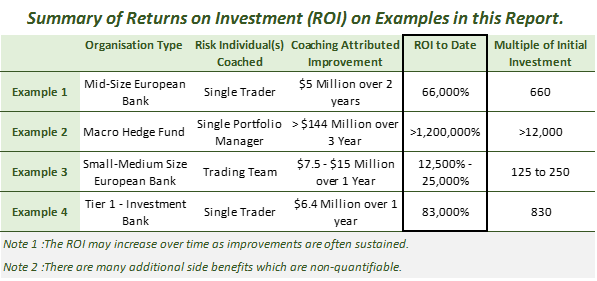
It is not always easy to demonstrate the benefits or returns possible from coaching, often the results are not clearly quantifiable or easily determined. We have however attempted identified to capture some examples where we can demonstrate the returns. These examples are based on clients stating how much difference they think the coaching made. A previous article, The Extraordinary Returns from Investing in Coaching for Professional Traders and Portfolio Managers, highlights these examples. The table below summaries these. 

The exceptional returns on investment highlighted sometimes do appear ridiculously off the scale, however the client themselves expressed these as fair summations. Part of the reason for such exceptional returns, is the size of the notional values when people are trading in  financial markets, a small difference in actual performance, can translate into major gains in financial terms. One aspect not captured in these examples, is the difference the coaching made on non-measurable aspects. A client we have just finished working with, not included in these examples, has reported how he is seeing so many other improvements in all areas of his working (and non-working) life. This was reflected in his end of year review at his firm, a tier 2 investment bank with some 2000 employees in the trading business worldwide. Each employee has an end of year review whereby they are given a star rating, only a handful of employees receive a 5 star rating, even a 4 star rating is not readily given out. This year the individual was given a 5 star rating, as opposed to the 3 star rating he has always previously received. In addition, he is now being put into the firms management programme, something that was not even on the radar for him previously. It is worth pointing out that in terms of performance, he has just had his best ever trading year out of 15 years trading, more than doubling last year's performance. His story is not atypical by any means, we have received much feedback similar to this. 

Why on earth would I employ a coach for my traders?

In response to this statement made at the very beginning. I hope I have laid down a strong case why a firm should employ coaching for his traders. Whilst the case is strong alone based on performance alone, banks are under pressure to demonstrate steps they are taking to raise standards of professionalism within their trading businesses. In the UK, the Fair and Effective Markets Review (FEMR), demands this of banks. A more complete list of the many benefits of our work can be seen on our website at http://www.alpharcubed.com/coaching.

Steven Goldstein is a leading Performance Coach working with Traders, Banks and Hedge funds at AlphaRCubed Ltd: To know more about Alpha R Cubed, visit their website www.alpharcubed.com or email Steven at steven.goldstein@alpharcubed.com

To view a brochure on their work click the link here

To subscribe to their monthly newsletter, email info@alpharcubed.com, and request brochure and or newsletter. 

Follow Steven on Twitter and Linkedin

Join the flourishing linkedin group Trader, Trading & Risk Psychology.


Wednesday, 28 October 2015

'Behavioural Trading. - A new name for an old blog.

I have been running this blog for some years now in various disguises. In the early days I shared my views on markets, whilst also adding occasional thoughts about Trading Psychology and Behaviour. I then started to focus more on my thoughts about trader performance and trader behaviour. I felt that there was more than enough talk and discussion about the market, about price action, about central banks; 'will they, won't they, should they, shouldn't they'. I admittedly also lapsed on my blogging, posting occasionally, about once every 2 to 4 months. I stayed active managing the Linked-in group 'Trader, Trading and Risk Psychology', which continues to grow and thrive, and at the same time, I have continued building up my business as a 'Performance Coach' working with traders. This continues to proceed, and I am delighted with the outcomes that my clients are now seeing from my work, I have shared a few examples on a recent post (Which I shamelessly plug here).

The post, which I shamelessly plugged, highlights just some of many examples where traders, who have passed through my coaching programmes, are now making significantly more money than they ever were, whilst at the same time being far happier and more content. I have now worked with many hundreds of traders over many years, first as a trader than a coach, I feel I have continued to grow and learn from them all. During this time, my views on trading psychology, trading performance and trading behaviour have transformed and taken on a very different shape. My earlier contentions about trader performance were largely shaped and coloured (or for you on the other side of the great pond 'colored') by my own experiences as a trader working inside investment banks. However my views have come along way since then, twisted and contorted by others sharing their experiences and travails with me, shaped by my own journey into Gestalt Psychology, which has opened up a whole new world, and continually polished by additional reading and learning. It is this journey which has led me to this place, and to the renaming of my blog, 'The Being of Trading'. For it is not enough to just do the right actions that lead to success in trading, rather it is to know and understand 'how you are', the 'being' of trading, both as a person and as a trader, which is where true success come from. I often use a quote made famous by Sir Edmund Hilary 'Its not the mountain we conquer, its ourselves'. That as true in his world, as it is in the world of trading, where the mountain is replaced by the  'market'.

That is what I aim to focus on with this blog from now: How one 'is' a trader, and how one applies their own personality, beliefs and attitudes to their trading. I will discuss and explore what I have learned and what I have discovered along my journey. About how engaging with risk and uncertainty requires special skills and capabilities, which everyone has within them, but which are so rarely understood and often so poorly practiced. I can not promise that I will be update this as regularly as I currently hope to, so please bear with me and be patient. - I do hope to bring some valuable insights over the months and even years ahead, which I believe will prove valuable to many people, themselves battling to succeed in the world of risk.  In the meantime please feel free to follow me on Twitter @chrysalisperfco, where I will post and re-tweet interesting articles on related themes. i also hope to turn this blog into an email newsletter. If anyone woul like to subscribe to the email newsletter, then please email me your name and email address. My contact details are at the bottom of this post. 

My first article , will ask 'Whether one can actually make money from trading on a consistent basis'. I ask this question, because this is a theme which has come up on more than one occasion with clients. Until then thank you and kind regards.

Steven Goldstein
steven.goldstein@alpharcubed.com 
Twitter @chrysalisperfco


Tuesday, 13 October 2015

The Extraordinary Returns from Investing in Coaching for Professional Traders and Portfolio Managers.


The last few years have seen a sharp growth in the use of coaching for developing trading and investment performance. This growth echoes in the many ways the rise of ‘Executive Coaching’, which is used to develop top leadership talent, and elite ‘Sports Coaching’ which is used to develop top sporting talent. The growth of performance coaching for traders still face many challenges, including an inability to provide data to a results driven industry which shows the ‘added-value’ from coaching. However for the first time, ‘Alpha R Cubed’, a bespoke trader and portfolio manager performance coaching business, has attempted to show the returns possible from using coaching to improve trading performance. This article highlights four examples of the work of their coaches taken from a wide body of work over recent years.

The table below summaries the results of the examples used in this article. The results seem exceptional, and as Alpha R Cubed's Managing Director Steven Goldstein explained, we were almost a bit embarrassed when we did our calculations, we had to keep double checking the numbers, or wondering whether we right to claim these improvements. However when we thought about it, we decided to use these, as they were deemed by our clients the additional returns which they feel would not of happened without the coaching:
  
What exactly is Performance Coaching for Traders, Investment and Portfolio Managers?

Performance Coaching is an immensely powerful process whereby a coach works with an individual to challenge and support them to achieve greater levels of performance. The coaching occurs in a series of one to one meetings held off the trading floor and spaced out over several months. The coaching is supported by various forms of analysis including risk profiling, personality assessment, 360 degree feedbacks, and behavioral questionnaires. In helping explain what the coaching tries to achieve, Alpha R Cubed’s Steven Goldstein likes to quote Sir Edmund Hillary, ‘It’s not the mountain we conquer, but ourselves.’ He says for many traders, often the problem is the enemy within, the coaching supports and helps traders to overcome the enemy within and then turn it into the ally within. As a consequence people start to improve and even master their abilities in key areas of performance, they become better at engaging with risk, better at managing risk, and better at making decisions in uncertain situations.
 
Examples of the Performance Coaching with Attributed Returns.

In all the following examples, the client firm stated the added-value that they believe resulted from the particular piece of coaching work. The clients involved provided permission to publish the details, though they did request anonymity in order that confidentiality is maintained.

Example 1

The individual was an experienced FX trader who had consistently returned a profit of about $2.5 million per year in recent years. A respectable performance for a mid-size franchise FX business, however the head of trading felt this individual could achieve higher levels of performance.

The coaching explored the trader’s way of working, approach and attitudes. This trader was highly talented but felt that he could not significantly improve performance without sacrificing low levels of volatility, or risking a counter-reaction to his performance. The coaching worked on raising the individual’s self-awareness to a point whereby he became more conscious of powerful drivers influencing behaviours which he had previously been blind to. As the coaching proceeded the trader started to introduce adaptions and a more proactive approach to his trading. 

By the end of the first year of coaching the trader had achieved a profit for the year of around $4 million, the following year this increased to $6 million. Collectively, the two years since the coaching have seen the trader generate an improvement to the bottom-line of an additional $5 million. This equated to an ROI of over 66,000%. Whilst this is extraordinary in any ones language, it is probably on the conservative side given that it excludes continued future performance and other non-quantifiable benefits. Furthermore, if the traders run rate remains elevated at around $6 million per year, then it is feasible that the return over 5 years would equate to an ROI of over 200,000%. Whilst this is a good example, it is not extreme  nor untypical.

Example 2
Where higher levels of capital and leverage are available, the return on investment can be considerably higher as this example shows. A newly hired portfolio-manager at a leading hedge fund had been highly successful as a bank trader. His first year at the hedge fund had however been somewhat underwhelming, achieving only a small positive return for the year, and finishing in the bottom 10% of PMs at the firm. This particular fund does not normally retain PMs who perform poorly in their first year; however, in light of his potential, they decided to give him a further chance and enlisted one of Alpha R Cubed’s coaches to help him.

It was apparent he had struggled to make the difficult transition from bank to hedge fund. There was a very different trading and risk environment at the hedge fund and the pressure to perform was far more intense. The coach worked with the individual to help raise his awareness of the issues which were impacting his performance, investigating the roots of his trading style, and exploring the unconscious biases at work in his trading. His approach to risk, which he had applied at the bank, needed some serious modifications, whilst his attitude to discipline and money management needed to be re-appraised. The individual soon started to transform how he worked, adding a new level of discipline and incorporating new practices and processes. The results were almost immediate, and by the end of the next six months not only was he retained but he was given an additional injection of capital to trade with. His second year at the firm saw a dramatic turnaround, placing him in the firms top 5% of their PMs. His total P&L for that year saw an increase of over $48 million, whilst in the subsequent two years he exceeded this still further.

In its raw form, compared to a situation where had the firm decided to let the individual leave, the ROI equated to a first year return of over 410,000%. The exact numbers for the PM’s performance in the subsequent 2 years were not available, however it is known that both years were in excess of the $48 million achieved in the first year after coaching. It is therefore fair to assume that ROI on this particular investment is so far at least 1,230,000%. It could be argued that the returns in this case are exaggerated, since the individual always had the potential; however the firm recognized the contribution the coaching made and that it was the catalyst for him to fulfill that potential. Furthermore, even if the coaching had achieved only a fraction of this success, it still would have represented an extraordinary return. 

This fund subsequently adopted the coaching to improve the ‘on-boarding’ process for new hires, and as a consequence the success rate of new hires has significantly improved. This is a great example of how supporting people in high pressure trading roles, pays huge dividends. It is felt that many firms fail to support people adequately when it comes to the human aspect of performance. This was brought home further by a recent research paper published by Citibank*. This explored the positive effects that active people management practices, which includes coaching, has on performance at hedge funds. The paper found that over a 3 year period, funds that invested heavily in active people management, outperformed funds that under-invested by around 600bp on total AUM. In hard numbers, this approximates to enhanced returns of around $200 million per year for every $10 billion of AUM.
*Exploring the Concept and Characteristics of “People Alpha”: Citi Prime Finance, October 2013.

Example 3

This example highlights a more broad based improvement across a whole team rather than

a specific individual. The coaching had been working for two years with 12 traders and desk heads within the fixed income, currency and commodity (FICC) trading business of a small to mid-size European bank. After two years the head of the business sent an email stating the following:-

‘We are again looking forward to cooperation for this year, last year we improved our trading P/L by more than 10 MIO GBP and I would argue that our cooperation was a big part of the success.’ 


We do not know how much of an increase this was in percentage terms, however we do know that for a small to mid-size European Bank, this was a sizable increase. And when compared to the average performance within the entire industry, where average revenues for FICC trading business for the year were around 7% lower than the previous year, this was an even more outstanding outcome.

It is not possible to know how much the coaching contributed directly to this, if one conservatively assumes that the coaching contributed to around half the improvement, this equates to an ROI of around 12,500%, whilst full credit for the improvement would equate to an ROI of over 25,000%. This may understate the full contribution, since the improvements are often maintained. Thus potentially this could equate to an ROI over a 5 year period of anything from 62,000% to 125,000%.

Goldstein does admit states that ‘it is not always easy to know the true value of their contribution, after all ‘a rising tide lifts all boats’ ’. Alpha R Cubed rely on feedback from clients as the best indicators of value. A good example of this is shown in feedback a ‘Business Head’ provided to the ‘Head of Talent’ at a Tier 1 investment bank client. The ‘Head of Talent’ had requested an assessment of the value of the coaching to the business. The following is taken from the manager’s reply:

‘Trader 1: Best year prior to coaching $6m (Over an 11 year period). Years since: $32m followed by $20m this year. (He started mid-way through 2007 and was flat p/l but just shy of $7m by year end)

Trader 2: Best year prior to coaching $0m (Associate, showed promise but revenue wasn't happening for some reason). Since he has $8m and $12m this year.

Trader 3: Best year prior to coaching $8m; subsequently $28m and $15m

Trader 4: Best year prior to coaching $3m: subsequently $22m (just one year since).

Now obviously market conditions have played a part, as well as luck etc. But one trader who has declined to take part in the 'coaching' has turned out to be the lowest revenue producer for the past two years having been consistently the highest for the previous 5. Also, all the individuals that have taken part have become easier to manage, show greater teamwork and just appear to be happier overall. The positive impact on the group has been profound.’


Example 4

Whilst the coaching focuses mainly on developing potential, sometimes it is remedial in

nature. An experienced swaps trader at a bank was struggling to recover from a serious downturn. When the coach met with the trader he was down $2 million dollars for the year and bleeding confidence. Soon after starting the coaching, the trader had lost a further $400,000 and closing in on his yearly stop-loss. The coach suggested he cease running risk to help him get his head ‘sorted’ and to stem the negative spiral .Then the coach worked with him to explore and help him understand the complexities of his situation which had taken him on this negative spiral. After a few weeks the trader re-started taking risk and within a couple of months was starting to make money again. With his confidence improving he continued to get further back into the markets, and by the end of that year he had made back almost $1,400,000 from the low. The next year he achieved almost $5 million profit for that year, his best at that bank.

Net from the low the trader was up over $6,400,000. This equated to a ROI of over 83,000% or 830 times the investment.

These typical examples highlight the potential returns from ‘Performance Coaching for Professional Traders, Portfolio and Money Managers. It is worth also re-emphasizing that there are many other non-quantifiable benefits from the coaching, these range from improving people’s resilience, and reducing stress and anxiety, to helping enhance the organizational and risk culture within a business. A more complete list of the many benefits can be seen on Alpha R Cubed's website at http://www.alpharcubed.com/coaching.

AlphaMind podcast #107 A US Navy Seal Commander, A Mindfulness Expert, and Self-Compassion

In the brutal world of trading and markets, we can often turn in on ourselves, and end up becoming our biggest problem. The ability to stay ...